
- SUSTAINABILITY AT IEU


Due to the Day of the adoption of the Universal Declaration of Human Rights, our Student Parliament held an online conference dedicated to human and student rights in different countries
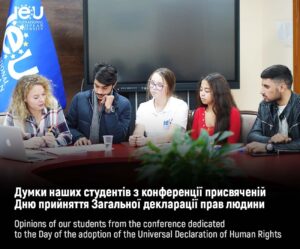 Due to the Day of the adoption of the Universal Declaration of Human Rights, our Student Parliament held an online conference dedicated to human and student rights in different countries
Meet the opinions of our students:
 Oleksandra Podik, a student of European IT School, “Human rights are a set of freedoms and legal possibilities related to the existence of people in society. Each person is an individual, but everyone has the same rights despite the age, religion and gender. In the 21st century, human rights have become even more important because of the emergence of such a term as bullying. All violations are penalized by law. Therefore, everyone has a lot of rights, but we know just a small part of them. Conferences organized by our university allow discovering what you really need without examining plenty of information.”Momin Raza, a student of European Medical School.
“The right of every man is diminished when the right of one man is threatened. Human Rights hold up the vision of a free, just and peaceful world and set minimum standards for how individuals and institutions everywhere should treat people.
However, one will not hesitate to admit that there is confusion prevailing as to its precise nature and scope and the mode of international law as to the protection of these rights. One valuable lesson that the history of human rights teaches us is that they are not static but are developed in response to new modes of political thoughts and changes in the international environment.”
George Emeka“Human rights in Nigeria are protected under the current constitution of 1999. In 1979, Nigeria adopted a presidential system in order to properly instate the right of choosing who rules them with a new constitution. This constitution guarantees fundamental human rights that are constantly in violation. In May 2013, Nigeria’s House of Representatives voted to pass the Same-Sex Marriage Bill, which prohibits gay marriage and public displays of affection between same-sex couples and allots fourteen years in prison to those engaged in same-sex relationships. This bill also allows punishment for those knowingly associating with those identifying as members of the LGBT community or aiding these individuals in becoming married or pursuing that lifestyle. The punishment for abetting gay marriage is 5 years imprisonment.
According to the US Department of Labor, 31% of Nigerian children (around 14,000,000 children) aged 5 to 14 years old are working children who engage in forced labor in various sectors. According to the International Labor Organization, over 15 million children in Nigeria are estimated to be child laborers. According to the Department’s List of Goods Produced by Child Labor or Forced Labor, instances of child labor have been observed in the agricultural sector where children participate in the production of cocoa, cassava, and sand. Fundamental Human Rights include the Right to Life, the Right to Dignity of Human Person, the Right to Acquire and Own Immovable Property anywhere in Nigeria.
This round-the-world trip to human rights helped us to realize the current situation and find out opinions of our students about human rights in different countries